 Danet
DanetOverview
@danet/graphql adds schema-first GraphQL to a Danet application, modeled on NestJS's @nestjs/graphql. You import GraphQLModule.forRoot(...) in a module, declare resolver classes as injectables, and the endpoint is served by the same HTTP server as the rest of your application, with dependency injection, guards, and standard GraphQL error responses. Execution is handled by the reference graphql-js implementation.
Under the hood the module reaches the running application through the APPLICATION_HOST token and mounts its route on the application's Hono router during bootstrap.
Installation
The package is published on JSR and requires @danet/core 2.12.0 or newer:
deno add jsr:@danet/graphqlQuickstart
Supply your schema as SDL type definitions, mark a class with @Resolver(), and bind its methods to root fields with @Query / @Mutation:
import { DanetApplication, Module } from 'jsr:@danet/core';
import { GraphQLModule, Query, Resolver } from 'jsr:@danet/graphql';

const typeDefs = `
	type Query {
		hello: String
	}
`;

@Resolver()
class HelloResolver {
	@Query()
	hello() {
		return 'world';
	}
}

@Module({
	imports: [GraphQLModule.forRoot({ typeDefs })],
	injectables: [HelloResolver],
})
class AppModule {}

const app = new DanetApplication();
await app.init(AppModule);
await app.listen(3000);
The endpoint executes operations sent as POST /graphql with a JSON body (query, optional variables and operationName), and also queries sent as GET /graphql?query={ hello }:
curl -X POST http://localhost:3000/graphql \
  -H 'Content-Type: application/json' \
-d '{ "query": "{ hello }" }'{ "data": { "hello": "world" } }Options
GraphQLModule.forRoot accepts:
| Option | Type | Default | Description |
|---|---|---|---|
typeDefs | string | (required) | Schema definition language type definitions, the source of truth. |
path | string | /graphql | Path the endpoint is mounted at. |
playground | boolean | false | Serve GraphiQL to browser requests (Accept: text/html) on path. |
Custom path
GraphQLModule.forRoot({ typeDefs, path: '/api/gql' });The endpoint is then served at /api/gql and nothing is mounted at /graphql.
Playground
GraphQLModule.forRoot({ typeDefs, playground: true });With the playground enabled, opening the endpoint in a browser serves an interactive GraphiQL editor querying your schema: write queries with autocompletion and inline validation, run them, and browse the generated schema documentation. Requests with any other Accept header keep executing operations normally, so the same path serves both browsers and API clients.
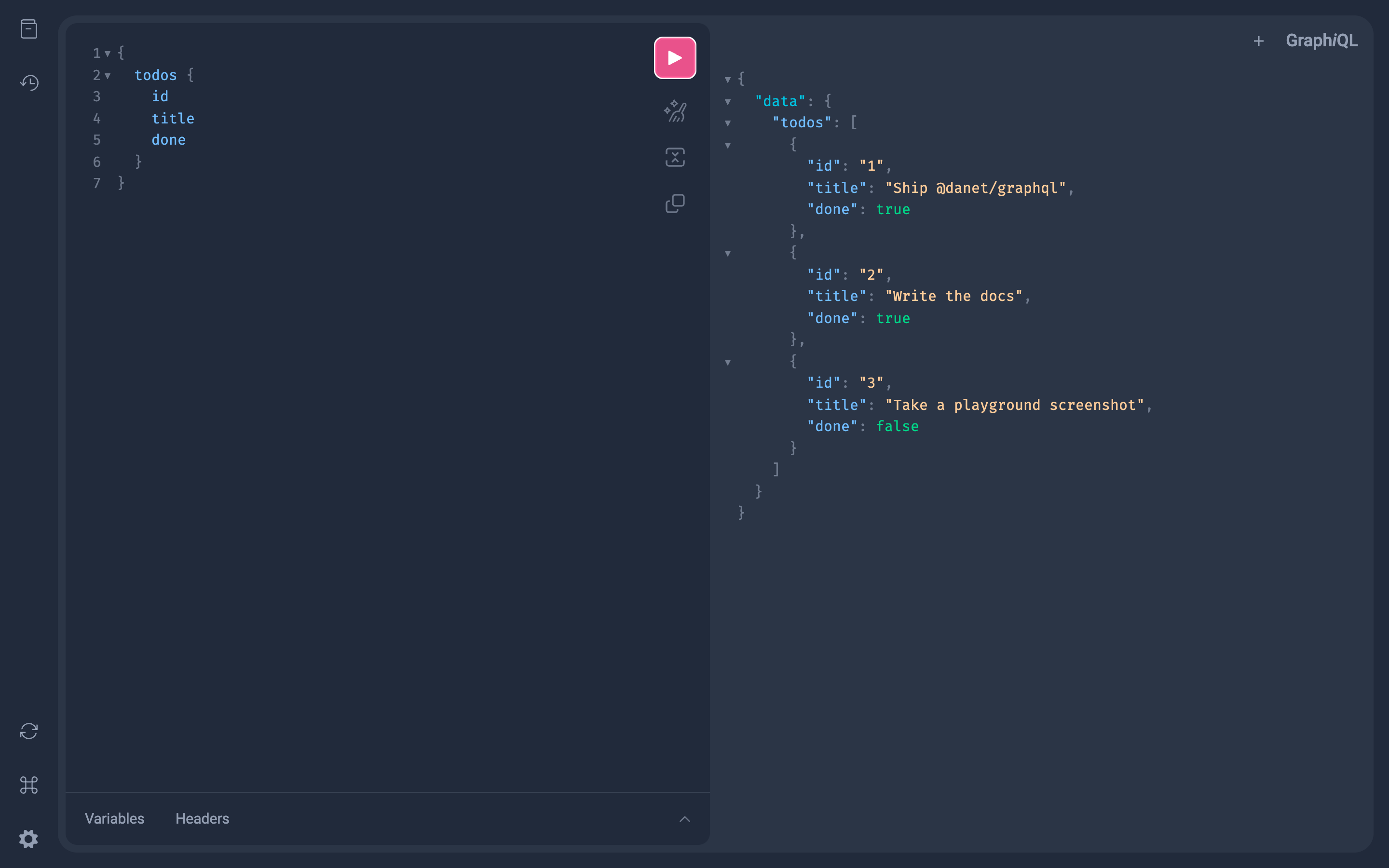
The playground is off by default; keep it for development rather than production.
Startup validation
app.init() fails fast with a descriptive error when:
- the type definitions are not valid SDL, or produce an invalid schema;
- a
@Query/@Mutationdecorated method names a field that does not exist on the corresponding root type.
Nothing broken ever starts serving.
Limitations
- Schema-first only. Code-first schema generation (
@ObjectType/@Field) and GraphQL subscriptions are planned follow-ups. SCOPE.REQUESTinjectables are per-resolution. A request-scoped injectable consumed by a resolver or guard is created per resolved root field, not per HTTP request (unlike controller routes, where one request is one handler call).- The playground loads GraphiQL from a CDN (unpkg), so the browser opening it needs network access.